World index ... Africa ... Seychelles
Travelers word index

Seychelles

Continents
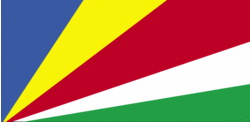
Seychellois flag

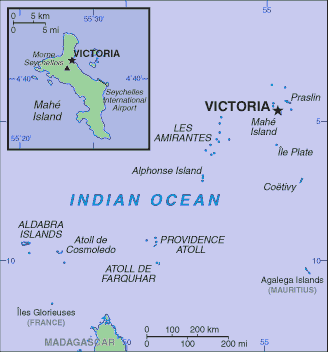
Seychelles is located in archipelago in the Indian Ocean, northeast of Madagascar.

Land in Seychelles is Mahe Group is granitic, narrow coastal strip, rocky, hilly; others are coral, flat, elevated reefs.

Seychellois land covers an area of 455 square kilometers which is 2.5 times the size of Washington, DC
As for the Seychellois climate; tropical marine; humid; cooler season during southeast monsoon (late May to September); warmer season during northwest monsoon (March to May).

Seychellois (singular and plural) speak Creole 91.8%, English 4.9% (official), other 3.1%, unspecified 0.2% (2002 census).

Seychelles country profile, Travel advice for Seychelles

Seychellois Map
Places of note in Seychelles
Victoria
Regions of Seychelles
Anse aux Pins
Anse Boileau
Anse Etoile
Anse Royale
Au Cap
Baie Lazare
Baie Sainte Anne
Beau Vallon
Bel Air
Bel Ombre
Cascade
English River
Glacis
Grand Anse Mahe
Grand Anse Praslin
Inner Islands
Les Mamelles
Mont Buxton
Mont Fleuri
Plaisance
Pointe Larue
Port Glaud
Roche Caiman
Saint Louis
(SE01)
(SE02)
(SE03)
(SE04)
(SE05)
(SE06)
(SE08)
(SE10)
(SE12)
(SE13)
(SE14)
(SE15)
(SE16)
(SE18)
(SE19)
(SE20)
(SE21)
(SE23)
Seychelles (general)
Takamaka

A lengthy struggle between France and Great Britain for the islands ended in 1814, when they were ceded to the latter. Independence came in 1976. Socialist rule was brought to a close with a new constitution and free elections in 1993. The most recent presidential elections were held in 2001; President RENE, who had served since 1977, was re-elected. In April 2004 RENE stepped down and Vice President James MICHEL was sworn in as president.

Country profile: Seychelles

Map of SeychellesAfter an ominous, post-independence start which saw them lurch from a coup, through an invasion by mercenaries to an abortive army mutiny and several coup attempts, the Seychelles have attained stability and prosperity.

Citizens of the Indian Ocean archipelago enjoy a high per capita income, good health care and education.

But just a year after independence in 1976, the Seychelles appeared to be heading down the path of instability which has plagued many African states.

AT-A-GLANCE


The prime minister, France Albert Rene, overthrew the president, James Mancham, and embarked on a programme aimed at giving poorer people a greater share of the country's wealth.

His coup, though bloodless, resulted in about 10,000 islanders fleeing the country. Four years later, with the help of Tanzanian troops, Mr Rene thwarted an attempt by South African mercenaries to restore Mr Mancham.

An army mutiny in 1982, followed by several attempted coups, suffered a similar fate.

But in 1991, possibly in response to pressure from foreign creditors and aid donors, Mr Rene restored multi-party democracy.

The country's economy depends heavily on a fishing industry and upmarket tourism; the latter is vulnerable to downturns in the global travel market. Fine beaches and turquoise seas are among the main attractions.

The archipelago is home to an array of wildlife, including giant tortoises and sea turtles. Much of the land is given over to nature reserves.

President: James Michel

James Michel succeeded France Albert Rene, who led the country for almost three decades before stepping down in April 2004.

President James Michel taking oath of office, April 2004

In July 2006 Mr Michel won a five-year term in presidential elections.

A former vice president, he had served alongside Mr Rene since 1977, when a bloodless coup brought the long-term leader to power.

Mr Michel pledged to hold a more open dialogue and to involve the private sector in the debt-ridden national economy. His critics say the privatisation process has been too slow.

Mr Michel, a former teacher, entered politics in 1974. He had a 16-year military career and retired from the armed forces in 1993 with the rank of colonel.

In the 2006 elections he gained nearly 54% of the vote compared with the almost 46% won by Anglican priest Wavel Ramkalawan. In the 2001 polls Ramkalawan won 45% compared with Rene's 54%.

The president is the head of state and appoints the Council of Ministers - an advisory body. Most members of the legislative body, the National Assembly, are directly elected.

  • Foreign minister: Patrick Pillay
  • Finance minister: Danny Faure

    The government controls much of the islands' media, and operates radio and TV stations and the sole daily newspaper.

    Freedom of speech has improved since one-party rule was abolished in 1993, and private or pro-opposition publications have been robust in their reporting despite tough libel laws.

    However, the opposition weekly Regar has regularly been sued for libel by the authorities. In October 2006 it stopped publication in protest against what it called constant threats from the government.

    Steep licensing fees have discouraged the development of privately-owned broadcast media.

    Multi-channel cable and satellite TV services are widely available. The BBC World Service and Radio France Internationale are available on FM.

    The press

  • Seychelles Nation - government daily
  • The People - ruling party weekly
  • Le Nouveau Seychelles Weekly - opposition weekly
  • Regar - opposition weekly

    Television

  • SBC TV - state-run, operated by Seychelles Broadcasting Corporation (SBC)

    Radio

  • SBC - operates national mediumwave (AM) service and music station Paradise FM

    News agency

  • Seychelles Agence Press

    Since independence in 1976, per capita output in this Indian Ocean archipelago has expanded to roughly seven times the old near-subsistence level. Growth has been led by the tourist sector, which employs about 30% of the labor force and provides more than 70% of hard currency earnings, and by tuna fishing. In recent years the government has encouraged foreign investment in order to upgrade hotels and other services. At the same time, the government has moved to reduce the dependence on tourism by promoting the development of farming, fishing, and small-scale manufacturing. Sharp drops illustrated the vulnerability of the tourist sector in 1991-92 due largely to the Gulf War, and once again following the 11 September 2001 terrorist attacks on the US. Growth slowed in 1998-2002, and fell in 2003, due to sluggish tourist and tuna sectors, but resumed in 2004, erasing a persistent budget deficit. Growth turned negative again in 2005. Tight controls on exchange rates and the scarcity of foreign exchange have impaired short-term economic prospects. The black-market value of the Seychelles rupee is half the official exchange rate; without a devaluation of the currency, the tourist sector may remain sluggish as vacationers seek cheaper destinations such as Comoros, Mauritius, and Madagascar.

    Seychellois natural resources include fish, copra, cinnamon trees

    41 granitic and about 75 coralline islands

    Seychellois religion is Roman Catholic 82.3%, Anglican 6.4%, Seventh Day Adventist 1.1%, other Christian 3.4%, Hindu 2.1%, Muslim 1.1%, other non-Christian 1.5%, unspecified 1.5%, none 0.6% (2002 census).

    Natural hazards in Seychelles include lies outside the cyclone belt, so severe storms are rare; short droughts possible.

    Travel Advice on Seychelles

    Seychelles

    This advice has been reviewed and reissued with an amendment to the Summary and Health section (leptospirosis).  The overall level of the advice has not changed.

    SUMMARY

    • You should be aware of petty thieves on beaches.

    • The threat from terrorism is low.  But you should be aware of the global risk of indiscriminate terrorist attacks, which could be against civilian targets, including places frequented by foreigners.

    • Most visits to Seychelles are trouble-free.  The main type of incident for which British nationals require consular assistance in Seychelles is for the replacement of lost and stolen passports (a few cases each year).

    • We strongly recommend that you obtain comprehensive travel and medical insurance before travelling.  You should check any exclusions, and that your policy covers you for the activities you want to undertake.  Please see:  Travel Insurance


    SAFETY AND SECURITY

    Money
    Seychelles foreign currency regulations require visitors to pay for most services in hard currency.  As a general guide, you must pay for all hotel rooms and anything eaten or drunk in a hotel (even by those not resident in the hotel) in hard currency.  You may also be required to pay for car hire, guided tours and recreational activities such as scuba diving in hard currency.
    However, if you pay in foreign cash, expect to receive change in Seychelles rupees even though you cannot then spend them in the same place. Consider using a credit card. Credit cards are widely accepted.
    While all hard currencies are supposedly acceptable, some establishments refuse Sterling, as the owners prefer to work only in US dollars or in Euros.
    Seychelles rupees can be used in bars, restaurants and nightclubs not connected to hotels and in local shops and markets.  All Seychelles rupees must be obtained at official rates with designated dealers e.g. banks.  Barclays Bank has more branches than most in Seychelles and have ATM machines.  Any other transaction is illegal and penalties can be severe.


  • What is this world index all about?