World index ... Africa ... Sao Tome and Principe
Travelers word index

Sao Tome and Principe

Continents
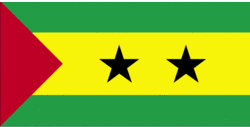
Sao Tomean flag

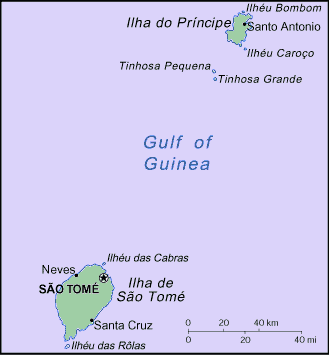
Sao Tome and Principe is located in Western Africa, islands in the Gulf of Guinea, straddling the Equator, west of Gabon.

Land in Sao Tome and Principe is volcanic, mountainous.

Sao Tomean land covers an area of 1001 square kilometers which is more than five times the size of Washington, DC
As for the Sao Tomean climate; tropical; hot, humid; one rainy season (October to May).

Sao Tomean(s) speak Portuguese (official).

Sao Tome and Principe country profile, Travel advice for Sao Tome and Principe

Sao Tomean Map
Places of note in Sao Tome and Principe
São Tomé
Regions of Sao Tome and Principe
Príncipe
São Tomé
Sao Tome and Principe (general)

Discovered and claimed by Portugal in the late 15th century, the islands' sugar-based economy gave way to coffee and cocoa in the 19th century - all grown with plantation slave labor, a form of which lingered into the 20th century. Although independence was achieved in 1975, democratic reforms were not instituted until the late 1980s. Though the first free elections were held in 1991, the political environment has been one of continued instability with frequent changes in leadership and coup attempts in 1995 and 2003. The recent discovery of oil in the Gulf of Guinea is likely to have a significant impact on the country's economy.

Country profile: Sao Tome and Principe

Map of Sao TomeSao Tome and Principe, once a leading cocoa producer, is poised to profit from the commercial exploitation of large offshore reserves of oil.

But arguments have arisen over how to spend the expected windfall, leading to increased political tension.

One of Africa's smallest countries, Sao Tome and Principe consists of two main islands of volcanic origin and a number of smaller islets.

AT-A-GLANCE


Boy cycles past colonial-era statue, Sao Tome From the late 1400s Portugal began settling convicts on Sao Tome and establishing sugar plantations with the help of slaves from the mainland. The island was also important in the transshipment of slaves.

The colony's aspirations for independence were recognised after the 1974 coup in Portugal and at first the Movement for the Liberation of Sao Tome and Principe was the country's sole political party. However, the 1990 constitution created a multi-party democracy. The island of Principe assumed autonomy in 1995.

Sao Tome and Principe is trying to shake off its dependence on the cocoa crop. Falls in production and prices left the island state heavily reliant on foreign aid. The government has been encouraging economic diversification and is set to exploit the billions of barrels of oil which are thought to lie off the country's coast.

Drilling is under way and commercial production is expected to begin within a few years.

Promoters of tourism say the islands have plenty for visitors to see. But hurdles include ignorance about the country, the difficulties of getting there, and what some say is an exaggerated fear of malaria.

President: Fradique de Menezes

Sao Tome president Fradique de Menezes, a wealthy cocoa exporter, was elected in July 2001 and re-elected in 2006.

A week-long military coup in July 2003 toppled his government, while the president was on a private visit to Nigeria. Mr De Menezes returned to Sao Tome after an agreement to restore democratic rule was reached with the coup leaders.

He is the son of a Portuguese father and Sao Tomean mother and had dual citizenship before dropping his Portuguese citizenship so that he could qualify as a presidential candidate.

The president wants revenues from new offshore oil fields to be used to improve public services. He is keen to reduce Sao Tome's isolation and favours stronger ties with West Africa.

Mr De Menezes is the country's third president, after Miguel Trovoada, who served two five-year terms, the maximum permitted by the constitution (1990-2001) and Pinto da Costa (1975-1991).

He studied in Portugal and Belgium and occupied several political and diplomatic positions, including foreign minister and ambassador in Europe.

The president's party, the Democratic Movement of Forces for Change (MDFM), won the March 2006 elections, making it possible for him to appoint an ally as prime minister. Previous governments have been co-habited by rival presidents and premiers.

  • Prime minister: Tome Vera Cruz
  • Foreign minister: Carlos Gustavo dos Anjos
  • Finance minister: Maria Tebus Torres

    Freedom of expression, guaranteed by the constitution, is also respected in practice. There are three privately-owned newspapers and one which is state-run.

    While the state controls a press agency and the only radio and television stations, no law forbids private broadcasting.

    Opposition parties receive free airtime and newsletters, and pamphlets criticising the government circulate freely.

    The press

  • Tela Non Diario de Sao Tome e Principe - daily, in Portuguese

    Television

  • Televisao Saotomense (TVS) - state-run national broadcaster

    Radio

  • Radio Nacional de Sao Tome e Principe - state-run national broadcaster

    This small, poor island economy has become increasingly dependent on cocoa since independence in 1975. Cocoa production has substantially declined in recent years because of drought and mismanagement, but strengthening prices helped boost export earnings in 2003. Sao Tome has to import all fuels, most manufactured goods, consumer goods, and a substantial amount of food. Over the years, it has had difficulty servicing its external debt and has relied heavily on concessional aid and debt rescheduling. Sao Tome benefited from $200 million in debt relief in December 2000 under the Highly Indebted Poor Countries (HIPC) program, and is expected to benefit from an additional round of HIPC debt relief in early 2006, to help bring down the country's $300 million debt burden. In August 2005, Sao Tome signed on to a new 3-year IMF Poverty Reduction and Growth Facility (PRGF) program worth $4.3 million. Considerable potential exists for development of a tourist industry, and the government has taken steps to expand facilities in recent years. The government also has attempted to reduce price controls and subsidies. Sao Tome is optimistic about the development of petroleum resources in its territorial waters in the oil-rich Gulf of Guinea, which are being jointly developed in a 60-40 split with Nigeria. The first production licenses were sold in 2004, though a dispute over licensing with Nigeria delayed Sao Tome's receipt of more than $20 million in signing bonuses for almost a year. Real GDP growth reached 6% in 2004, and also probably in 2005, as a result of increases in public expenditures and oil-related capital investment.

    Sao Tomean natural resources include fish, hydropower

    the smallest country in Africa; the two main islands form part of a chain of extinct volcanoes and both are fairly mountainous

    Sao Tomean religion is Catholic 70.3%, Evangelical 3.4%, New Apostolic 2%, Adventist 1.8%, other 3.1%, none 19.4% (2001 census).

    Natural hazards in Sao Tome and Principe include NA.

    Travel Advice on Sao Tome and Principe

    Sao Tome & Principe

    This advice has been reviewed and reissued with amendments to the Summary, Crime, Road Safety (International Driving Licence), Political Situation, Entry Requirements sections.  The overall level of the advice has not changed.

    SUMMARY

    • There is no British Embassy in São Tomé and Principe, but there is an Honorary British Consul in São Tomé.  São Tomé and Principe is covered from the British Embassy in Luanda, Angola.  Please see the General section of this travel advice for more details.

    • The threat from terrorism is low.  But you should be aware of the global risk of indiscriminate terrorist attacks which could be against civilian targets, including places frequented by foreigners.

    • Most visits to Sao Tome are trouble free.  The main type of incident for which British nationals require consular assistance is in relation to passports and identity documents.  Crime rates are generally low, but armed robberies do occur.

    • We strongly recommend that you obtain comprehensive travel and medical insurance before travelling.  You should check any exclusions, and that your policy covers you for the activities you want to undertake.  Please see Travel Insurance


    SAFETY AND SECURITY

    Crime

    Crime rates in São Tomé and Principe are generally low, but burglaries and armed robberies do occur.  Beware of pickpockets, particularly at the beach.  Take sensible precautions.  Safeguard valuables and cash.  Deposit them in a hotel safe, where practical.  Keep separate copies of important documents, including passports, separately.

    Political Situation

    São Tomé and Principe is generally peaceful.

    Economic difficulties and political rows over the handling of investments in the islands’ development occasionally lead to civil unrest.  You should avoid any demonstrations or large gatherings.

    Local Travel

    Seats on the small aircraft that operate between the main island of São Tomé and the smaller island of Principe need to be booked well in advance or there is a risk that you could become stranded.  On São Tomé, there are shared taxis but no other public transport in São Tomé and Principe.

    Road Safety

    You should bring a valid International Driving Licence if you wish to hire a car.

    Traffic is light but the majority of roads are in poor condition, particularly outside the capital.  Roads are badly lit.  Be particularly alert after dark to the danger of animals on the road.

    Air Safety

    The EU has published a list of air carriers that are subject to an operating ban or restrictions within the community.  You should check the following link to see whether this will affect your travel: http://europa.eu.int/comm/transport/air/safety/flywell_en.htm


    LOCAL LAWS AND CUSTOMS

    There are severe penalties for drug trafficking and use.
    It is our understanding that homosexual practices are illegal.


    ENTRY REQUIREMENTS

    British nationals require a visa to enter São Tomé and Principe.  This should be obtained before travel as problems can occur should you arrive without the necessary documentation.  You will also need a valid Yellow Fever certificate.  Visa enquiries should be directed to the nearest São Tomé Diplomatic Mission in Brussels: Sao Tome and Principe representation in Belgium; Telefax: (+32) (2) 7348815; E-mail: ambassade.sao.tome@skynet.be.  Specialist travel agents dealing with São Tomé and Principe may also be able to arrange visas.
    Single parents or other adults travelling alone with children should be aware that some countries require documentary evidence of parental responsibility before allowing lone parents to enter the country or, in some cases, before permitting the children to leave the country.  For further information on exactly what will be required at immigration please contact the São Tomé Diplomatic Mission in Brussels at the above address.


    HEALTH

    We strongly recommend that you obtain comprehensive travel and medical insurance before travelling, including cover for medical evacuation.  You should check any exclusions, and that your policy covers you for the activities you want to undertake.  Please see: Travel Insurance
    Medical facilities on São Tomé and Principe are limited and many health conditions would require evacuation to Europe, South Africa or Gabon for treatment.  You should therefore ensure that your insurance covers this.
    You will need a valid Yellow Fever certificate to enter São Tomé and Principe.  Malaria is endemic in São Tomé and Principe.  More than three-quarters of British travellers who contracted malaria in 2005 did not take preventive measures, such as taking malaria prevention tablets.  However, malaria can occur despite appropriate prevention, and therefore you should promptly seek medical care in the event of a fever or flu-like illness in the first year following your return from travelling to a malaria risk country.  Before travelling you should seek medical advice about the malaria risk in São Tomé and Principe.  There are frequent outbreaks of cholera. The levels of HIV/AIDS are uncertain, but you should be aware of the dangers of unprotected sex.
    You should seek medical advice before travelling and ensure that all appropriate vaccinations are up to date. For further information on health, check the Department of Health’s website at: DoH: Health Advice To Travellers


    GENERAL

    If things go wrong when overseas, please see: What We Can Do To Help
    There is no British Embassy in São Tomé and Principe, but there is an Honorary British Consul, Mr J Gomes, in São Tomé (Residencia Avenida, Avenida da Independencia, CP257, São Tomé, tel: +239 12 21026/7, fax: +239 12 21372).  São Tomé and Principe is covered from the British Embassy in Luanda, Angola.
    Credit cards are accepted in a very limited number of places.  You should confirm with the hotel, restaurant etc that they will accept your card before incurring expenditure.  There are no ATMs.  Travellers’ cheques are not accepted, and cash advances on foreign cards are not available.  It may be possible to remit funds in an emergency via Western Union whose website lists details of their agency on São Tomé.  You are strongly advised to check the latest position with your travel agent/tour company prior to travel, and to carry sufficient cash.


    OTHER

    Sao Tome & Principe Country Profile


  • What is this world index all about?