World index ... Africa ... Nigeria
Travelers word index

Nigeria

Continents
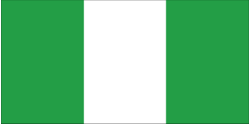
Nigerian flag

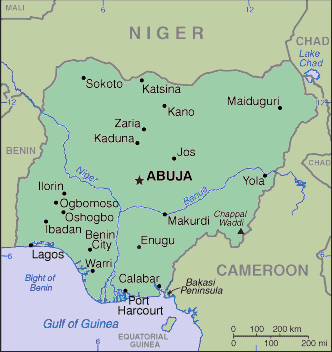
Nigeria is located in Western Africa, bordering the Gulf of Guinea, between Benin and Cameroon.

Nigeria has borders with Benin for 773km, Cameroon for 1690km, Niger for 1497km and Chad for 87km.
Land in Nigeria is southern lowlands merge into central hills and plateaus; mountains in southeast, plains in north.

Nigerian land covers an area of 923768 square kilometers which is slightly more than twice the size of California

As for the Nigerian climate; varies; equatorial in south, tropical in center, arid in north.

Nigerian(s) speak English (official), Hausa, Yoruba, Igbo (Ibo), Fulani.

Nigeria country profile, Travel advice for Nigeria

Nigerian Map
Places of note in Nigeria
Ogoyo
Kano
Ibadan
Kaduna
Port Harcourt
Benin-City
Maiduguri
Zaria
Aba
Jos
Ilorin
Oyo
Abeokuta
Abuja
Sokoto
Onitsha
Warri
Okene
Calabar
Katsina
Akure
Bauchi
Ebute Ikorodu
Makurdi
Minna
Effon Alaiye
Ilesa
Owo
Umuahia
Ondo
Damaturu
Ikot Ekpene
Iwo
Gombe
Jimeta
Regions of Nigeria
Abia
Abuja Federal Capital Territory
Adamawa
Akwa Ibom
Anambra
Bauchi
Bayelsa
Benue
Borno
Cross River
Delta
Ebonyi
Edo
Ekiti
Enugu
Gombe
Imo
Jigawa
Kaduna
Kano
Katsina
Kebbi
Kogi
Kwara
Lagos
Nassarawa
(NI10)
(NI12)
(NI17)
(NI18)
(NI20)
(NI34)
Niger
Nigeria (general)
Ogun
Ondo
Osun
Oyo
Plateau
Rivers
Sokoto
Taraba
Yobe
Zamfara

Following nearly 16 years of military rule, a new constitution was adopted in 1999, and a peaceful transition to civilian government was completed. The president faces the daunting task of reforming a petroleum-based economy, whose revenues have been squandered through corruption and mismanagement, and institutionalizing democracy. In addition, the OBASANJO administration must defuse longstanding ethnic and religious tensions, if it is to build a sound foundation for economic growth and political stability. Although the April 2003 elections were marred by some irregularities, Nigeria is currently experiencing its longest period of civilian rule since independence.

Country profile: Nigeria

Map of NigeriaAfter lurching from one military coup to another, Nigeria now has an elected leadership. But it faces the growing challenge of preventing Africa's most populous country from breaking apart along ethnic and religious lines.

Political liberalisation ushered in by the return to civilian rule in 1999 has allowed militants from religious and ethnic groups to express their frustrations more freely, and with increasing violence.

Thousands of people have died over the past few years in communal rivalry. Separatist aspirations have been growing, prompting reminders of the bitter civil war over the breakaway Biafran republic in the late 1960s.

AT-A-GLANCE


Oil and gas terminal, Niger delta The imposition of Islamic law in several states has embedded divisions and caused thousands of Christians to flee. Inter-faith violence is said to be rooted in poverty, unemployment and the competition for land.

The government is striving to boost the economy, which experienced an oil boom in the 1970s and is once again benefiting from high prices on the world market. But progress has been undermined by corruption and mismanagement.

The former British colony is one of the world's largest oil producers, but the industry has produced unwanted side effects.

The trade in stolen oil has fuelled violence and corruption in the Niger delta - the home of the industry. Few Nigerians, including those in oil-producing areas, have benefited from the oil wealth.

Nigeria is keen to attract foreign investment but is hindered in this quest by security concerns as well as by a shaky infrastructure troubled by power cuts.

President: Olusegun Obasanjo

Olusegun Obasanjo won a second term in April 2003, gaining more than 60% of the vote in Nigeria's first civilian-run presidential poll for 20 years. But opposition parties rejected the outcome, citing allegations of vote-rigging.

Nigeria's president

He began his first leadership stint in 1976 after the assassination of Brigadier Murtala Mohamed. In 1979 he earned the distinction of becoming Africa's first modern military leader to hand over power to civilian rule. Renouncing politics, he then returned to his home state to set up a pig farm.

In 1995 he was jailed for his part in an alleged coup plot against military dictator Sani Abacha, but was set free three years later by new military leader General Abubakar.

He became a civilian head of state in 1999 in elections that followed a transition programme started by Gen Abubakar. Mr Obasanjo set up an investigation into human rights abuses under military rule, released political prisoners and began a crackdown on corruption. But critics say he has failed to halt spiralling violence and religious and ethnic clashes.

His economic reform programme has won some plaudits; the president is pushing for privatisations, tax reform and greater transparency.

On the world stage, he helped to engineer a common plan for Africa's economic recovery - the New Partnership for African Development (Nepad). A key player in the Commonwealth, he reluctantly supported Zimbabwe's suspension over political violence in 2002.

Born in 1937, Olusegun Obasanjo is an ethnic Yoruba from the south-west of Nigeria. He joined the army in 1958 and came to prominence in 1970 as the officer who accepted the surrender of Biafran forces in the 1967-70 civil war.

Under the constitution, he is due to step down in 2007 at the end of his second term. His supporters want to amend the charter to allow him to stay in office, but their attempt was blocked by parliament in May 2006.

  • Vice president: Atiku Abubakar
  • Finance minister: Esther Nenadi Usman
  • Foreign minister: Joy Ogwu

    Nigeria's media scene is one of the most vibrant in Africa. State-run radio and TV services reach virtually all parts of the country and operate at a federal and regional level. All 36 states run their own radio stations, and most of them operate TV services.

    Newspaper stand, Lagos The media regulator reported in 2005 that more than 280 radio and TV licences had been granted to private operators.

    But TV stations in particular are dogged by high costs and scarce advertising revenues.

    Radio is the key source of information for many Nigerians. Television viewing tends to be centred more in urban areas, and among the affluent. International radio broadcasters, including the BBC, are widely listened to.

    There are more than 100 national and local newspapers and publications, some of them state-owned. They include well-respected dailies, popular tabloids and publications which champion the interests of ethnic groups. The lively private press is often critical of the government.

    Media freedom improved under President Obasanjo. But restrictive decrees remain in force; in 2004 rebroadcasts of foreign radio stations were banned and concern was expressed over a proposed media law.

    Citing high levels of violence, the media rights body Reporters Without Borders has said Nigerian journalists operate amid a "prevailing culture of brutality".

    The press

  • The Guardian - influential, privately-owned national daily
  • The Champion - Lagos-based daily
  • Daily Times - Lagos-based government daily
  • The Punch - privately-owned daily
  • New Nigerian - government daily, separate editions in Lagos and Kaduna
  • The Daily Independent - Lagos State-based daily
  • Daily Trust - Abuja-based daily
  • The Comet - private, daily
  • Vanguard - Lagos-based, widely-read daily
  • This Day - widely-read Lagos-based daily
  • The Daily Sun - Lagos-based
  • Newswatch - weekly news magazine
  • Tell - weekly news magazine

    Television

  • Nigerian Television Authority (NTA) - state-run, operates national and regional stations
  • Degue Broadcasting Network (DBN) - commercial
  • AIT - commercial, broadcasting in Lagos and Abuja and via satellite
  • Minaj TV - commercial, serves eastern Nigeria
  • Galaxy TV - commercial, serves western Nigeria
  • Channels TV - commercial

    Radio

  • Federal Radio Corporation of Nigeria (FRCN) - state-run, operates "Radio Nigeria" stations in Abuja, Lagos, Ibadan, Kaduna, Enugu
  • Voice of Nigeria - external service
  • Ray Power - commercial, operates music-based and speech-based networks

    News agency

  • News Agency of Nigeria (NAN) - government-owned

    Oil-rich Nigeria, long hobbled by political instability, corruption, inadequate infrastructure, and poor macroeconomic management, is undertaking some reforms under a new reform-minded administration. Nigeria's former military rulers failed to diversify the economy away from its overdependence on the capital-intensive oil sector, which provides 20% of GDP, 95% of foreign exchange earnings, and about 65% of budgetary revenues. The largely subsistence agricultural sector has failed to keep up with rapid population growth - Nigeria is Africa's most populous country - and the country, once a large net exporter of food, now must import food. Following the signing of an IMF stand-by agreement in August 2000, Nigeria received a debt-restructuring deal from the Paris Club and a $1 billion credit from the IMF, both contingent on economic reforms. Nigeria pulled out of its IMF program in April 2002, after failing to meet spending and exchange rate targets, making it ineligible for additional debt forgiveness from the Paris Club. In the last year the government has begun showing the political will to implement the market-oriented reforms urged by the IMF, such as to modernize the banking system, to curb inflation by blocking excessive wage demands, and to resolve regional disputes over the distribution of earnings from the oil industry. In 2003, the government began deregulating fuel prices, announced the privatization of the country's four oil refineries, and instituted the National Economic Empowerment Development Strategy, a domestically designed and run program modeled on the IMF's Poverty Reduction and Growth Facility for fiscal and monetary management. GDP rose strongly in 2005, based largely on increased oil exports and high global crude prices. In November 2005, Abuja won Paris Club approval for a historic debt-relief deal that by March 2006 should eliminate $30 billion worth of Nigeria's total $37 billion external debt. The deal first requires that Nigeria repay roughly $12 billion in arrears to its bilateral creditors. Nigeria would then be allowed to buy back its remaining debt stock at a discount. The deal also commits Nigeria to more intensified IMF reviews.

    Nigerian natural resources include natural gas, petroleum, tin, iron ore, coal, limestone, niobium, lead, zinc, arable land

    the Niger enters the country in the northwest and flows southward through tropical rain forests and swamps to its delta in the Gulf of Guinea

    Nigerian religion is Muslim 50%, Christian 40%, indigenous beliefs 10%.

    Natural hazards in Nigeria include periodic droughts; flooding.

    Travel Advice on Nigeria

    Nigeria

    This advice has been reviewed and reissued with an amendment to the Terrorism/Security section. The overall level of the advice has not changed.

    SUMMARY

    • We advise against all travel to the riverine areas of Bayelsa, Delta and Rivers States.  Riverine areas are generally regarded as being those accessible only by boat.  This is because of the high risk of kidnapping, armed robbery and other armed attacks in these areas.

    • We advise against all but essential travel to Akwa Ibom State and the rest of Bayelsa, Delta and Rivers States, including Port Harcourt, because of the high risk of kidnapping, armed robbery and other armed attacks in these areas.  On 18 December 2006, two bombs exploded in Port Harcourt, one in a Shell residential compound and the other at Agip’s headquarters.  On 23 January 2007 a British and a US national were taken hostage while driving to work in Port Harcourt.

    • There is a high risk of further kidnappings by armed militants around the oil and gas facilities in the Niger Delta.  In nine separate incidents since January 2006, 22 British nationals have kidnapped.  One Briton has been killed.  Since that time over 150 foreign nationals have been kidnapped in the Niger Delta area.  See the Terrorism/Security section of this travel advice for more details.

    • If you decide to travel to, or remain in, these areas you do so at your own risk.  The level of consular assistance we can provide in these areas is limited.  If your presence is essential, it would be reckless to travel to, or remain in, these areas unless you have taken appropriate professional security advice and have acted on it.

    • Campaigning for elections due in April 2007 has begun.  Localised unrest is likely and the security situation may deteriorate rapidly in the vicinity of election rallies.  The risk of crime in the Niger Delta is likely to increase in the run up to the elections.  You should remain extra-vigilant throughout this period.  See the Political Situation section of this travel advice for more details.

    • Localised outbreaks of civil unrest can occur at short notice.  Details and advice are circulated via the British High Commission's Community Liaison Officers' network.

    • Violent crime is especially prevalent in the south of the country, including Lagos.

    • The most common problems encountered by British nationals in Nigeria are attempts by scam artists to extract money from their intended victims.  These scams come in many forms and can cause considerable financial loss to victims.

    • You should be aware of the threat from terrorism in Nigeria.  A statement issued by Usama Bin Laden in February 2003 called for an uprising by Muslims in a number of countries including Nigeria.  He suggested that “faithful Muslims” rise up against the Nigerian Government.  He also referred to “support for brothers” in Nigeria in December 2004.

    • Outbreaks of Avian Influenza (Bird Flu) in Nigeria have resulted in one human fatality.  As a precaution, you should avoid live animal markets, poultry farms and other places where you may come into contact with domestic, caged or wild birds; and ensure poultry and egg dishes are thoroughly cooked.  For further information see Avian Influenza section below and also read Avian and Pandemic Influenza Factsheet.

    • We strongly recommend that you obtain comprehensive travel and medical insurance before travelling.  You should check any exclusions, and that your policy covers you for the activities you want to undertake.  Please see:  Travel Insurance.


    SAFETY AND SECURITY

    Terrorism/Security

    We advise against all travel to the riverine areas of Delta, Bayelsa and River States.  Riverine areas are generally regarded as being those accessible only by boat.  We also advise against all but essential travel to Akwa Ibom State and the rest of Bayelsa, Delta and Rivers States, including Port Harcourt.  This is because of the high risk of kidnapping, armed robbery and other armed attacks in these areas.
    If you consider that your journey is essential it would be reckless to travel to, or remain in, these areas unless, and until, you have taken full, appropriate professional security advice and have acted on it. You must be vigilant at all times and make sure that your local host and family know your travel plans and timings.  You should register with the British Deputy High Commission in Lagos on arrival.
    There has been an increase in crime and armed attacks against expatriates in the Niger Delta.  Militants have carried out attacks on oil and gas facilities in the Delta and we believe that armed groups may be planning further attacks on oil and gas industry targets in the Delta, and other non oil and gas industry targets and individuals throughout the country. On 18 December 2006 two bombs exploded in Port Harcourt, one in a Shell residential compound and the other at Agip’s headquarters.  Further attacks are possible. As a result Shell have evacuated all dependants from the residential compound in Port Harcourt.  Other companies have followed suit.
    There is an ongoing high risk of politically or financially motivated kidnapping, especially in the Niger Delta.  In nine separate incidents 22 British nationals were kidnapped between January and November 2006, one of whom was killed.  On 23 January 2007, a British national and a US national were taken hostage while driving to work in Port Harcourt.
    Individuals have also been kidnapped at their place of work, including from offshore facilities.  We received reports of an attempt to try to lure an expatriate to a meeting at a remote location near Port Harcourt.  It was believed that this was an attempted kidnap.  When arranging meetings in Nigeria you should ensure that the contact is known to you, and that the meeting is held at a secure location.
    The government has heightened its security presence in Port Harcourt.  Many companies have introduced strict restrictions on travel.  The risk has been further increased by the closure of Port Harcourt airport as journeys to the city now involve long road transfers through insecure areas. If you are a resident British national, you should follow your employer’s local security guidelines.
    If you do visit, you should not travel between dusk and dawn, and avoid going to public places in Port Harcourt frequented by expatriates, including bars and restaurants.
    You should be aware of the threat from terrorism in Nigeria.  A statement issued by Usama Bin Laden in February 2003 called for an uprising by Muslims in a number of countries, including Nigeria.  He suggested that "faithful Muslims" rise up against the Nigerian Government.  He also referred to “support for brothers” in Nigeria in December 2004.
    You should be aware of the global risk of indiscriminate terrorist attacks, which could be against civilian targets, including places frequented by foreigners.  Please read Security and General Tips and Risk of Terrorism when Travelling Overseas for further advice and information.
    Crime
    Violent street crimes including armed robberies, muggings and car-jackings are especially prevalent in the south of the country, including Lagos and Port Harcourt.
    Foreign visitors and residents can be targeted by scam artists.  The scams come in many forms, and can pose great financial loss to victims.  If you or your relatives or friends are asked to transfer money to Nigeria you should make absolutely sure that it is not part of a scam and that you have properly checked with the person receiving the money that they are requesting it.
    Scam artists are also targeting individuals in the UK.  There are a myriad of schemes in operation by West African criminal networks designed to facilitate victims parting with money, known as advance fee or 419 fraud.  Nigerian scam artists are also known to be targeting internet dating/personal sites with the intention of soliciting money from victims.  For further information an advance fee fraud please see:  West African advance fee Fraud Alert

    If you are concerned about someone who has travelled to Nigeria you should contact Consular Section of the Deputy High Commission, Lagos.

    Political Situation

    Nigeria Country Profile

    Demonstrations and outbreaks of localised civil unrest and violence can occur with little notice throughout the country.  There is a particular risk of election-related violence and harassment in the moths running up to national and regional elections in April 2007.  There have already been several incidents in and around the Niger Delta.  Other incidents have occurred in the Niger Delta (Bayelsa, Rivers, Delta, Imo and Anambra), North (Kano, Borno, Jigawa and Katsina) and Central Nigeria (Taraba, Plateau and Benue states), South West (Oyo and Lagos) and the Cross-Rivers and Ebonyi border.

    Details of those incidents are circulated to the British community via the British High Commission's Community Liaison Officers' network.

    Demonstrations for or against, Sharia law may occur in northern states and can become violent without warning.  There have also been demonstrations about developments in the Middle East.  British nationals are not specifically targeted.  However, you should take care to avoid large crowds, demonstrations or disturbances, especially if you are driving.

    Road Safety

    If you are expecting a greeter or driver to collect you at any of Nigeria’s international airports you should ensure that he/she can properly identify themselves, as bogus greeters are a problem.

    There are frequent reports of robberies and carjackings, some involving armed gunmen, on Nigeria's road network.  You should:
    • be vigilant when travelling on all major roads within Nigeria.
    • avoid travel after dark outside cities.
    • take care after dark within cities, avoiding secondary roads and areas where other traffic is light.
    • be particularly vigilant when sitting in traffic jams or at traffic lights at night.
    • keep your car windows and doors locked and valuables out of sight.

    Traffic in many of Nigeria's major cities can be chaotic and slow moving.  Serious traffic jams in Lagos are not uncommon.  Short journeys that normally take minutes can sometimes take hours.  We advise you to take a mobile telephone with you when travelling by car so that you can stay in touch with family, friends and employers.  We also advise you to have a supply of bottled water in your vehicle at all times.

    There are authorised as well as unauthorised vehicle checkpoints throughout Nigeria.  Some are for security checks, others to extort small payments of money.  You should slow down at any type of checkpoint and use common sense at all times.

    Public transport is dangerous.  Taxis and long distance buses are poorly maintained and are often driven by fraudulent drivers.  Most major hotels offer cars for hire with drivers.  We would recommend that you use these where possible.

    Road travel in Lagos is banned between 07:00 and 10:00 on the last Saturday of every month for municipal road clean up; police vigilantly enforce the ban.

    Air Safety

    Port Harcourt airport is currently closed for maintenance.

    The EU has published a list of air carriers that are subject to an operating ban or restrictions within the EU.  You should check http://europa.eu.int/comm/transport/air/safety/flywell_en.htm to see whether this will affect your travel.

    There are a number of domestic airlines, although following a series of crashes there are concerns about their reliability.

    British government staff based in Nigeria are strongly urged to use Virgin Nigeria and Aerocontractors wherever possible but have discretion to use other airlines to destinations not served by these two airlines where they judge that the risks of travel by road are at least as great.
    Sea Safety
    There have been attacks of piracy/armed robbery against ships at anchor in Nigerian waters and at many of the rivers and harbours in the Niger Delta area.  We advise mariners to take appropriate precautions.


    LOCAL LAWS AND CUSTOMS

    Nigeria has the largest Muslim population in Africa.  You should exercise discretion in behaviour and dress, particularly in the north and during the Holy month of Ramadan and when visiting religious sites.
    The Sharia penal code has been introduced in 12 northern states (Sokoto, Zamfara, Kebbi, Kano, Yobe, Borno, Katsina, Jigawa, Bauchi, Kaduna, Niger and Gombe).  Homosexuality by Muslims in those states can attract a sentence of 100 lashes if the defendant is unmarried or stoning if married or divorced.  Alcohol consumption, infidelity and theft can attract harsh sentences including stoning, amputation, lashings or long prison terms.  Non-Muslims are not bound by Sharia law.
    Homosexuality is illegal under Federal law, covering the whole of Nigeria, but individuals are rarely prosecuted.
    Possession, use of or trafficking in illegal drugs is a serious offence and can result in lengthy prison sentences and heavy fines.

    It is illegal to import beer, mineral water, soft drinks, sparkling wine, fruits, vegetables, cereals, eggs, textile fabrics, jewellery, and precious metals.  It is illegal to export pieces of African art, particularly antiques, without written authorisation from the Department of Antiquities.   You should contact the Nigerian High Commission for specific information regarding customs requirements.

    Photography in airports may lead to arrest.


    ENTRY REQUIREMENTS

    All British nationals travelling to Nigeria must hold a valid visa before entering the country.  British nationals planning to work in Nigeria must obtain the correct visa before doing so.  For further information on entry requirements, we advise visitors to contact the Nigerian representation in the UK.

    It is recommended that you obtain a new passport if your passport has less than six months validity remaining otherwise you may be turned away by airlines.

    Single parents or other adults travelling alone with children should be aware that some countries require documentary evidence of parental responsibility before allowing lone parents to enter the country or, in some cases, before permitting the children to leave the country.  For further information on exactly what will be required at immigration please contact the Nigerian High Commission in London.


    HEALTH

    You should ensure that you have comprehensive travel and medical insurance, which covers a provision for medical evacuation.  You should check any exclusions, and that your policy covers you for the activities you want to undertake.  Please see Travel Insurance.
    Basic, limited medical facilities are available in some parts of Nigeria.
    HIV/AIDS is prevalent in Nigeria and there are also regular outbreaks of cholera and measles.  Polio is also endemic in Nigeria.  In 2006 there were 1,077 polio cases and northern Nigeria accounted for 56% of global cases.  The Global Polio Eradication Initiative reports that Kano, Katsina and Jigawa States have been classified as “very high risk” for polio.
    Malaria is endemic in Nigeria.  More than three-quarters of British travellers who contracted malaria in 2005 did not take preventive measures, such as malaria prevention tablets. However, malaria can occur despite appropriate prevention, and therefore you should promptly seek medical care in the event of a fever or flu-like illness in country or in the first year following your return from travelling to a malaria risk country.  Before travelling you should seek medical advice about the malaria risk in Nigeria.
    You should seek medical advice before travelling and ensure that all appropriate vaccinations are up to date.  For further information on health, check the Department of Health’s website at: www.dh.gov.uk.
    Avian Influenza (Bird Flu)
    The first confirmed case of Avian Influenza (Bird Flu) in Nigeria was announced by the World Organisation for Animal Health on 8 February 2006.  The outbreak occurred on a commercial chicken farm at Jaji in Kaduna State.  Since then, bird flu has been detected at other farms in Kaduna and in Kano, Plateau, Katsina, Bauchi, Nassarawa, Yobe, Rivers, Benue, Anambra, Ogun, Lagos, Taraba, Jigawa, Kwara, Delta, Borno, Sokoto, Adamawa, Edo, Enugu and the Federal Capital Territory (Abuja and surrounds).  The first human case confirmed by the World Health Organisation was that of a 22-year-old Lagos woman who died on 16 January 2007.  Since the end of 2003, a number of human deaths have also occurred in Azerbaijan, Egypt, Iraq, Vietnam, Thailand, Indonesia, Cambodia, Turkey and China.
    The risk to humans from Avian Influenza is believed to be very low. However, as a precaution you should avoid visiting live animal markets, poultry farms and other places where you may come into close contact with domestic, caged or wild birds; and ensure poultry and egg dishes are thoroughly cooked.
    The World Health Organisation (WHO) has warned of the possibility that the Avian Influenza outbreaks could lead at some point to a human flu pandemic, if the virus mutates to a form which is easily transmissible between people.
    British nationals living longer term in an Avian-Influenza affected region should take personal responsibility for their own safety in the event of a future pandemic, including considering their access to adequate healthcare and ensuring travel documents are up to date.
    You should read this advice in conjunction with the Avian and Pandemic Influenza Factsheet.


    GENERAL

    If things go wrong when overseas, please see:  What We Can Do To Help.
    We strongly advise British nationals staying in Nigeria for three months or more to register at the British High Commission in Abuja, British Deputy High Commission in Lagos, or Liaison offices in Kaduna, Port Harcourt, or with the Honorary Consuls in Kano and Warri.
    As many crimes involve the theft of British passports, you should keep a photocopy of your passport, separately from your passport.  This will speed up the process of issuing a new one.
    Airlines flying between Nigeria and London can occasionally become severely overbooked.  As a result, airlines advise travellers to reconfirm their return booking at least 48 hours before they are due to depart, and to check in early.
    Money
    Nigeria is a cash economy.  You should ensure that you bring enough currency (Sterling, US Dollars or Euros) to cover your costs.  It is illegal to change money on the street.  We strongly advise against the use of credit cards throughout Nigeria.  Travellers' cheques are difficult to cash in Nigeria.


    What is this world index all about?