World index ... Africa ... Mauritius
Travelers word index

Mauritius

Continents
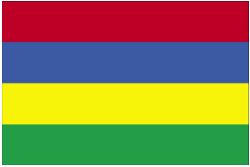
Mauritian flag

Mauritius is located in Southern Africa, island in the Indian Ocean, east of Madagascar.

Land in Mauritius is small coastal plain rising to discontinuous mountains encircling central plateau.

Mauritian land covers an area of 2040 square kilometers which is almost 11 times the size of Washington, DC
As for the Mauritian climate; tropical, modified by southeast trade winds; warm, dry winter (May to November); hot, wet, humid summer (November to May).

Mauritian(s) speak Creole 80.5%, Bhojpuri 12.1%, French 3.4%, English (official; spoken by less than 1% of the population), other 3.7%, unspecified 0.3% (2000 census).

Mauritius country profile, Travel advice for Mauritius

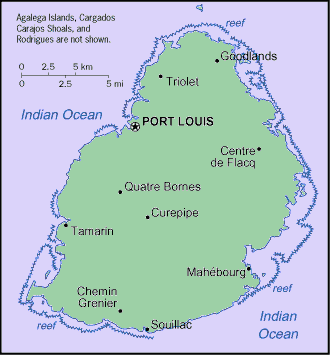
Mauritian Map
Places of note in Mauritius
Port Louis
Curepipe
Quatre Bornes
Triolet
Goodlands
Centre de Flacq
Bel Air
Mahébourg
Saint Pierre
Le Hochet
Baie du Tombeau
Bambous
Rose Belle
Chemin Grenier
Rivière du Rempart
Grand Baie
Plaine Magnien
Pailles
Surinam
Lalmatie
New Grove
Rivière des Anguilles
Terre Rouge
Petit Raffray
Moka
Pamplemousses
Montagne Blanche
Grand Bois
Long Mountain
Plaine des Papayes
Grande Pointe aux Piments
Brisée Verdière
Nouvelle France
Grand Gaube
Poste de Flacq
Regions of Mauritius
Agalega Islands
Black River
Cargados Carajos
Flacq
Grand Port
Mauritius (general)
Moka
Pamplemousses
Plaines Wilhems
Port Louis
Rivière du Rempart
Rodrigues
Savanne

Although known to Arab and Malay sailors as early as the 10th century, Mauritius was first explored by the Portuguese in 1505; it was subsequently held by the Dutch, French, and British before independence was attained in 1968. A stable democracy with regular free elections and a positive human rights record, the country has attracted considerable foreign investment and has earned one of Africa's highest per capita incomes. Recent poor weather and declining sugar prices have slowed economic growth, leading to some protests over standards of living in the Creole community.

Country profile: Mauritius

Map of MauritiusMauritius, a volcanic island of lagoons and palm-fringed beaches in the Indian Ocean, has a reputation for stability and racial harmony among its mixed population of Asians, Europeans and Africans.

The island has maintained one of the developing world's most successful democracies and has enjoyed years of constitutional order.

It has preserved its image as one of Africa's few social and economic success stories, being a sugar and clothing exporter and a centre for upmarket tourism. But Mauritian exports have been hit by strong competition from low-cost textile producers and the loss of sugar subsidies from Europe.

AT-A-GLANCE


Mauritian capital, Port Louis Various cultures and traditions flourish in peace, though Mauritian Creoles, descendants of African slaves who make up a third of the population, live in poverty and complain of discrimination.

Mauritius was uninhabited when the Dutch took possession in 1598. Abandoned in 1710, it was taken over by the French in 1715 and seized by the British in 1810.

It gained independence in 1968 as a constitutional monarchy, with executive power nominally vested in the British monarch. It became a republic in 1992. The island of Rodrigues and other smaller islets also form part of the country.

Mauritius claims sovereignty over the Chagos islands, which lie around 1,000 km to the north-east. The British territory, which was separated from Mauritius in 1965, is home to the US military base on Diego Garcia. The British government oversaw the forced removal of the Chagos islanders to Mauritius to make way for the base.

The country is home to some of the world's rarest plants and animals. But human habitation and the introduction of non-native species have threatened its indigenous flora and fauna.

The dodo - a flightless bird and a national symbol - was hunted into extinction in the 17th century.

President: Sir Anerood Jugnauth

Prime minister: Navin Ramgoolam

Navin Ramgoolam

Former Prime Minister Navin Ramgoolam of the Social Alliance returned to power after defeating Paul Berenger of the Mauritian Militant Movement in elections in July 2005.

The new premier promised to tackle rising inflation and unemployment. To this end, he advocates trade agreements that give preference to Mauritian exports, including sugar and textiles.

Born in 1947, Mr Ramgoolam served as prime minister between 1995 and 2000. He is a doctor and lawyer.

His predecessor Paul Berenger, a white Mauritian of French descent, became the island's first non-Hindu prime minister in 2003.

  • Foreign minister: Madan Dulloo
  • Finance minister: Rama Sithanen

    The constitution guarantees freedom of expression and of the press. State-owned Mauritius Broadcasting Corporation (MBC) operates radio and TV services and generally reflects government thinking. Privately-run radio stations were introduced in 2002.

    Daily newspapers and weeklies offer balanced coverage in several languages. They are often critical of both the government and the opposition parties.

    Multichannel TV is available in Port Louis, where the MMDS network Telestar transmits a variety of rebroadcast programming. BBC World Service radio is available via a mediumwave (AM) relay.

    The press

  • L'Express
  • Le Mauricien
  • Le Matinal

    Television

  • MBC - state-run, operates three channels

    Radio

  • MBC - state-run, broadcasting in English, French, Indian languages and Chinese. MBC stations include Radio Maurice 1 and 2, Kool FM, Taal FM and One World FM.
  • Top FM - private FM station, Bollywood music and Western pop
  • Radio One - first private radio station
  • Radio Plus - private

    News agency

  • Mauritius News - UK-based, offers monthly updated news in English

    Since independence in 1968, Mauritius has developed from a low-income, agriculturally based economy to a middle-income diversified economy with growing industrial, financial, and tourist sectors. For most of the period, annual growth has been in the order of 5% to 6%. This remarkable achievement has been reflected in more equitable income distribution, increased life expectancy, lowered infant mortality, and a much-improved infrastructure. Sugarcane is grown on about 90% of the cultivated land area and accounts for 25% of export earnings. The government's development strategy centers on expanding local financial institutions and building a domestic information telecommunications industry. Mauritius has attracted more than 9,000 offshore entities, many aimed at commerce in India and South Africa, and investment in the banking sector alone has reached over $1 billion. Mauritius, with its strong textile sector, has been well poised to take advantage of the Africa Growth and Opportunity Act (AGOA).

    Mauritian natural resources include arable land, fish

    the main island, from which the country derives its name, is of volcanic origin and is almost entirely surrounded by coral reefs

    Mauritian religion is Hindu 48%, Roman Catholic 23.6%, other Christian 8.6%, Muslim 16.6%, other 2.5%, unspecified 0.3%, none 0.4% (2000 census).

    Natural hazards in Mauritius include cyclones (November to April); almost completely surrounded by reefs that may pose maritime hazards.

    Travel Advice on Mauritius

    Mauritius

    This advice has been reviewed and reissued.  The overall level of the advice has not changed.

    SUMMARY

    • Drug trafficking carries severe penalties.

    • Although crime levels are low, you should be aware that thefts, assault and rape do occur.

    • The threat from terrorism is low.  But you should be aware of the global risk of indiscriminate terrorist attacks, which could be against civilian targets, including places frequented by foreigners.

    • The Cyclone season in Mauritius is generally between November to May.

    • Around 95,000 British tourists visited Mauritius every year.  Most visits are trouble free.  The main type of incident for which British nationals require consular assistance in Mauritius is petty theft of passports and other belongings.  Other occurrences include water-sports and road traffic accidents.

    • We strongly recommend that you obtain comprehensive travel and medical insurance before travelling.  You should check any exclusions, and that your policy covers you for the activities you want to undertake.  Please see: Travel Insurance.


    SAFETY AND SECURITY

    Crime

    Crime levels are low in Mauritius, although incidents of theft, assault and rape are increasing.  You should take sensible precautions against theft particularly in parts of downtown Port Louis and other tourist centres.  There have been some attacks involving the use of weapons.  Take care of bags and valuables when visiting popular tourist areas such as Grand Baie, Pereybere, Flic en Flac and Tamarin.  Break-ins at self-catering accommodation can occur.  Avoid renting accommodation from unregistered proprietors.  All accommodation should be registered with the Ministry of Tourism.  Only transact business with enterprises that have a permanent place of business, rather than street or beach vendors.  Ensure that water-sport operators hold a valid permit issued by the Ministry of Tourism.

    Report any incidents to the Police du Tourisme on the hotline number 213 2818 (available from anywhere on the island).

    Take sensible precautions.  Safeguard valuables and cash.  Deposit them in hotel safes, where practical.  Keep copies of important documents, including passports separately.

    Political Situation

    Mauritius Country Profile.

    Relations with the UK are close, though demonstrations outside the British High Commission occur sporadically because of issues relating to the British Indian Ocean Territory.

    Local Travel

    You can drive on your UK driving licence, but you must have it with you at all times.  The standard of driving here varies and there are frequent, though minor accidents (19,000 per year) so you should take special care when driving yourself.  After dark, pedestrians and unlit two-wheeled vehicles can be a particular hazard.

    Air Safety

    The EU has published a list of air carriers that are subject to an operating ban or restrictions within the community.  You should check the following link to see whether this will affect your travel:  http://europa.eu.int/comm/transport/air/safety/flywell_en.htm


    LOCAL LAWS AND CUSTOMS

    The importation of illicit drugs carries severe penalties.  Trafficking carries life sentences (i.e.  up to 45 years).  Prosecutions take a year or more to come to court, with detention the norm up until the trial.  Bail is not usually granted for drug-related crimes, regardless of the type of drug.  By way of example, the importation of 15 grams of cannabis could attract a one-year custodial sentence and a fine of 100,000 Mauritian rupees.  It is also illegal to possess or import cigarette papers.
    You may carry common medicinal drugs for your own personal use provided that use is covered or justified by a prescription and the drugs were obtained legally from a pharmacy.  Scheduled drugs, such as psychotropic preparations (eg tranquillisers, hypnotics), narcotics (eg morphine) and other strong pain killers require by law authorisation before import.  You are advised to contact:  Mauritian representation in the UK, for information.  Requests for special authorisation and import permits are usually processed in 24-48 hours if all supportive documents are submitted with the application.  The basic information required is the name and address of the applicant, photocopy of the personal details page of the applicant’s passport, flight details, address in Mauritius, length of stay, description and quantities of drugs to be carried.  You are also expected to carry copies of valid medical prescriptions or certificates.  Requests to carry medicines used for drug rehabilitation treatment (eg methadone) should be submitted well in advance as their processing may require security clearance.  In all cases the quantities of drugs carried must be compatible with the duration of stay.
    Homosexuality is illegal in Mauritius.


    ENTRY REQUIREMENTS

    British nationals do not need to obtain visas before arrival.  A visa, normally valid for 3 months, will be issued on arrival to holders of valid British passports in possession of return tickets.  You may be refused entry to Mauritius if your passport has less than six months validity remaining or if you do not have a return ticket.  If you intend to work in Mauritius, you must arrange a work permit in advance.
    Single parents or other adults travelling alone with children should be aware that some countries require documentary evidence of parental responsibility before allowing lone parents to enter the country or, in some cases, before permitting the children to leave the country.  For further information on exactly what will be required at immigration, please contact the Mauritian High Commission:  Mauritian representation in the UK.


    HEALTH

    We strongly recommend that you obtain comprehensive travel and medical insurance before travelling.  You should check any exclusions, and that your policy covers you for the activities you want to undertake.  Please see:  Travel Insurance.
    All passengers arriving from an area where yellow fever exists will need a yellow fever certificate.  Further information can be obtained from the Mauritian High Commission (co-located with the Mauritius Tourism Promotion Authority), Mauritian representation in the UK.
    Chikungunya, a viral infection spread by mosquitoes, is mainly a problem in the warmer months (October-May).  Precautionary measures to avoid being bitten should be taken throughout the year.  You should be aware that mosquitoes are active during both day and night.  Further information on Chikungunya can be found on the World Health Organisation website at:  http://www.who.int/csr/don/2006_02_17a/en/.
    Although there are no malarial mosquitoes in Mauritius, on arrival at the airport an officer from the Ministry of Health may ask you for a blood sample if you have travelled from a country where malaria is prevalent.
    Stonefish stings are uncommon but can in some cases be fatal.  You should obtain urgent medical attention if stung.  Many hotels stock anti-venom serum.
    Stray and sometimes vicious dogs are common in Mauritius.  However, rabies is not a risk.
    You should seek medical advice before travelling and ensure that all appropriate vaccinations are up to date.  For further information on health, check the Department of Health’s website at: www.dh.gov.uk.
    NATURAL DISASTERS
    Cyclones may strike Mauritius between November and May.  They can cause extensive damage to property.  The authorities have a well-structured system of phased warnings.  During a cyclone, you are not allowed to leave your accommodation and car insurance policies often cease to be valid.  Cyclone information for the Indian Ocean Region is available at:  http://metoc.npmoc.navy.mil//jtwc.html.


    GENERAL

    If things go wrong when overseas please see:  What We Can Do To Help.

    The police sometimes ask foreigners to show some identity.  You should carry photocopies of the relevant pages of your passport and driving licence and leave the original in a safe place.
    Money
    ATMs are widely available in most towns in the island and at large shopping centres.  Visa cards are accepted by most hotels, restaurants and large retailers.


  • What is this world index all about?