
 Search
Traveling Luck for Lesotho. Lesotho, Africa
Lesotho is located in Southern Africa, an enclave of South Africa.
Land in Lesotho is mostly highland with plateaus, hills, and mountains.
Basotho land covers an area of 30355 square kilometers which is slightly smaller than Maryland
Lesotho has borders with South Africa for 909km.
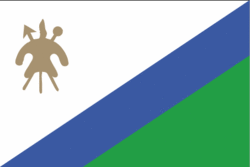 Basotho national flag (Flag of Lesotho)
 Lesotho country profile
 Travel advice for Lesotho
As for the Basotho climate; temperate; cool to cold, dry winters; hot, wet summers.
Mosotho (singular), Basotho (plural) speak Sesotho (southern Sotho), English (official), Zulu, Xhosa.
Places of note in Lesotho
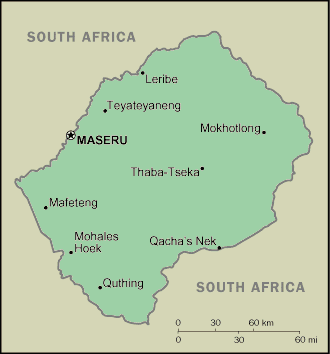 Basotho map
Regions of Lesotho
Basutoland was renamed the Kingdom of Lesotho upon independence from the UK in 1966. The Basuto National Party ruled for the first two decades. King MOSHOESHOE was exiled in 1990, but returned to Lesotho in 1992 and reinstated in 1995. Constitutional government was restored in 1993 after 7 years of military rule. In 1998, violent protests and a military mutiny following a contentious election prompted a brief but bloody intervention by South African and Botswanan military forces under the aegis of the Southern African Development Community. Constitutional reforms have since restored political stability; peaceful parliamentary elections were held in 2002.
Small, landlocked, and mountainous, Lesotho relies on remittances from miners employed in South Africa and customs duties from the Southern Africa Customs Union for the majority of government revenue. However, the government has recently strengthened its tax system to reduce dependency on customs duties. Completion of a major hydropower facility in January 1998 now permits the sale of water to South Africa, also generating royalties for Lesotho. As the number of mineworkers has declined steadily over the past several years, a small manufacturing base has developed based on farm products that support the milling, canning, leather, and jute industries, as well as a rapidly expanding apparel-assembly sector. The latter has grown significantly, mainly due to Lesotho qualifying for the trade benefits contained in the Africa Growth and Opportunity Act. The economy is still primarily based on subsistence agriculture, especially livestock, although drought has decreased agricultural activity. The extreme inequality in the distribution of income remains a major drawback. Lesotho has signed an Interim Poverty Reduction and Growth Facility with the IMF.
Basotho natural resources include water, agricultural and grazing land, diamonds, sand, clay, building stone
landlocked, completely surrounded by South Africa; mountainous, more than 80% of the country is 1,800 meters above sea level
Basotho religion is Christian 80%, indigenous beliefs 20%.
Natural hazards in Lesotho include periodic droughts.
Travel Advice for Lesotho
LesothoSUMMARY
- There is no British High Commission in Lesotho, but there is an Honorary British Consul who can be contacted in consular emergencies only (see contact details below). All other enquiries should now be directed to the British High Commission in Pretoria.
- There have been incidents of muggings and vehicle hijacking in the past twelve months (some involving firearms). There have also been incidents of armed robbery in Maseru and there has been an increase in gun-related crime in Maseru in the lead up to the festive season. Sporadic demonstrations are possible.
- Do not walk around Maseru at night; and avoid driving in rural areas at night.
- Parliamentary elections will be held on 17 February 2007. You should monitor events through the local media and avoid all demonstrations, rallies and other large gatherings.
- The threat from terrorism is low. But you should be aware of the global risk of indiscriminate terrorist attacks, which could be against civilian targets, including places frequented by foreigners.
- Most visits to Lesotho are trouble-free. The main type of incident for which British nationals require consular assistance in Lesotho is for replacing lost or stolen passports, or help following medical problems. You should keep a photocopy of your passport with you and keep the original in a safe place.
- We strongly recommend that you obtain comprehensive travel and medical insurance before travelling. Medical insurance should cover possible medical evacuation by air. You should check any exclusions, and that your policy covers you for the activities you want to undertake. Please see: Travel Insurance.
SAFETY AND SECURITY
The threat from terrorism is low, but you should be aware of the global risk of indiscriminate terrorist attacks, which could be against civilian targets, including places frequented by foreigners. Please read Security and General Tips and Risk of Terrorism when Travelling Overseas for further information and advice.
Crime
There has been an increase in gun-related crime in Maseru in the lead up to the festive season.
Muggers in central Maseru, even in daylight, often target foreign nationals, frequently at knifepoint. You should not walk alone in isolated areas. Only carry essentials with you. Keep valuables out of sight. Do not walk around Maseru after dark and avoid driving in rural areas at night. When driving in urban centres, especially Maseru, keep doors locked, windows shut and valuables out of sight. Park in well-lit areas and do not pick up strangers. Take care at the approaches to main border crossings, particularly at night.
Armed car-jacking are increasing. If you are attacked, or your car is hijacked, do not resist.
Since the middle of 2005, Maseru has experienced a spate of armed robberies that have targeted hotels, restaurants and other businesses. There have been no serious injuries as a result but you are advised not to offer resistance should you be caught in the middle of an incident.
Take sensible precautions. Safeguard valuables and cash. Deposit them in hotel safes, where practicable. Keep separate copies of important documents, including passports.
Political Situation
The political situation is generally calm. There are periodic disturbances by students protesting about a change in government policy towards student bursaries. Parliamentary elections will be held on 17 February 2007. You should monitor events through the local media and avoid all demonstrations, rallies and other large public gatherings.
There have been three shooting incidences in 2006 involving high level political figures, most recently an attack on the residence of the Trade Minister on 24 November 2006 in which a Dutch aid worker was killed and her driver seriously injured.
Lesotho Country Profile
Local Travel
There is no effective public transport system or reliable taxi service in Lesotho.
Road Safety
Driving standards in Lesotho are poor and you should drive carefully. Local mini-bus taxis are poorly maintained, often uninsured and invariably ignore road safety rules. Animals roaming on the roads are a hazard, especially at night. A British driving licence or International driving licence is valid for use in Lesotho for up to three months. A local driving licence must then be obtained.
Air Safety
The EU has published a list of air carriers that are subject to an operating ban or restrictions within the community. You should check the following link to see whether this will affect your travel: http://europa.eu.int/comm/transport/air/safety/flywell_en.htm.
LOCAL LAWS AND CUSTOMS
ENTRY REQUIREMENTS
Single parents or other adults travelling alone with children should be aware that some countries require documentary evidence of parental responsibility before allowing lone parents to enter the country or, in some cases, before permitting the children to leave the country. For further information on exactly what will be required at immigration please contact the Lesotho's representation in the UK.
HEALTH
Lesotho has only very basic medical facilities. Expatriates use the medical facilities in Bloemfontein, South Africa; a one and a half-hour drive (140kms) from Maseru.
GENERAL