
 Search
Traveling Luck for Gabon. Gabon, Africa
Gabon is located in Western Africa, bordering the Atlantic Ocean at the Equator, between Republic of the Congo and Equatorial Guinea.
Land in Gabon is narrow coastal plain; hilly interior; savanna in east and south.
Gabonese land covers an area of 267667 square kilometers which is slightly smaller than Colorado
Gabon has borders with Congo (Brazzaville) for 1903km, Cameroon for 298km and Equatorial Guinea for 350km.
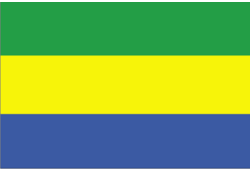 Gabonese national flag (Flag of Gabon)
 Gabon country profile
 Travel advice for Gabon
As for the Gabonese climate; tropical; always hot, humid.
Gabonese (singular and plural) speak French (official), Fang, Myene, Nzebi, Bapounou/Eschira, Bandjabi.
Places of note in Gabon
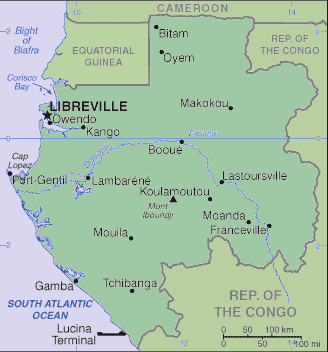 Gabonese map
Regions of Gabon
Only two autocratic presidents have ruled Gabon since independence from France in 1960. The current president of Gabon, El Hadj Omar BONGO Ondimba - one of the longest-serving heads of state in the world - has dominated the contry's political scene for almost four decades. President BONGO introduced a nominal multiparty system and a new constitution in the early 1990s. However, allegations of electoral fraud during local elections in 2002-03 and the presidential elections in 2005 have exposed the weaknesses of formal political structures in Gabon. Gabon's political opposition remains weak, divided, and financially dependent on the current regime. Despite political conditions, a small population, abundant natural resources, and considerable foreign support have helped make Gabon one of the more prosperous and stable African countries.
Gabon enjoys a per capita income four times that of most of sub-Saharan African nations. This has supported a sharp decline in extreme poverty; yet, because of high income inequality, a large proportion of the population remains poor. Gabon depended on timber and manganese until oil was discovered offshore in the early 1970s. The oil sector now accounts for 50% of GDP. Gabon continues to face fluctuating prices for its oil, timber, and manganese exports. Despite the abundance of natural wealth, poor fiscal management hobbles the economy. Devaluation of its currency by 50% in January 1994 sparked a one-time inflationary surge, to 35%; the rate dropped to 6% in 1996. The IMF provided a one-year standby arrangement in 1994-95, a three-year Enhanced Financing Facility (EFF) at near commercial rates beginning in late 1995, and stand-by credit of $119 million in October 2000. Those agreements mandated progress in privatization and fiscal discipline. France provided additional financial support in January 1997 after Gabon met IMF targets for mid-1996. In 1997, an IMF mission to Gabon criticized the government for overspending on off-budget items, overborrowing from the central bank, and slipping on its schedule for privatization and administrative reform. The rebound of oil prices in 1999-2000 helped growth, but drops in production hampered Gabon from fully realizing potential gains. In December 2000, Gabon signed a new agreement with the Paris Club to reschedule its official debt. A follow-up bilateral repayment agreement with the US was signed in December 2001. Gabon signed a 14-month Stand-By Arrangement with the IMF in May 2004, and received Paris Club debt rescheduling later that year. Short-term progress depends on an upbeat world economy and fiscal and other adjustments in line with IMF policies.
Gabonese natural resources include petroleum, natural gas, diamond, niobium, manganese, uranium, gold, timber, iron ore, hydropower
a small population and oil and mineral reserves have helped Gabon become one of Africa's wealthier countries; in general, these circumstances have allowed the country to maintain and conserve its pristine rain forest and rich biodiversity
Gabonese religion is Christian 55%-75%, animist, Muslim less than 1%.
Natural hazards in Gabon include NA.
Travel Advice for Gabon
GabonSUMMARY
- There is no British Embassy in Gabon. In an emergency, you can obtain consular assistance from the British Honorary Consul in Libreville. Please see the General section of this travel advice for more information.
- The threat from terrorism is low. You should be aware of the global risk of indiscriminate terrorist attacks, which could be against civilian targets, including places frequented by foreigners.
- We are not aware of any British nationals who have required consular assistance in Gabon in the past year. However, you should be aware that crime is increasing, particularly in Libreville and Port-Gentil.
- We strongly recommend that you obtain comprehensive travel and medical insurance before travelling. You should check any exclusions, and that your policy covers you for the activities you want to undertake. Please see: Travel Insurance.
SAFETY AND SECURITY
Crime is increasing, particularly in Libreville and Port-Gentil, including incidents of robbery and armed attacks. You should take sensible personal security precautions and maintain a high level of vigilance in public places. We recommend that you avoid carrying valuables or wearing jewellery in public. You should avoid isolated or poorer areas of towns and walking alone at night. We advise you to be cautious on quiet or isolated beaches in and around Libreville, and to avoid them altogether at night.
Following a number of carjackings within Libreville we recommend that you keep your car windows closed and car doors locked if you are travelling at night. Do not stop to pick up strangers. To avoid the risk of serious injury do not resist carjackers. You may find that an immobiliser that operates after the vehicle has been driven a short distance or a tracking device can help with the recovery of your vehicle.
Political Situation
Public demonstrations in Port Gentil have on occasion turned violent. You should avoid demonstrations, rallies and large public gatherings.
Local Travel
Road conditions are poor in most local areas and driving can be hazardous. During the rainy season from October to mid-December and mid-February to May many roads are passable only with a four-wheel drive vehicle. You should avoid travelling by road at night. Police checkpoints are common, where you may be asked to show your passport, driving licence or vehicle registration documents.
The EU has published a list of air carriers that are subject to an operating ban or restrictions within the community. You should check http://europa.eu.int/comm/transport/air/safety/flywell_en.htm to see whether this will affect your travel.
LOCAL LAWS AND CUSTOMS
ENTRY REQUIREMENTS
You will be asked to produce a yellow fever vaccination certificate on arrival in the country. Failure to do so may result in a further vaccination being administered, for which a charge is made.
Single parents or other adults travelling alone with children should be aware that some countries require documentary evidence of parental responsibility before allowing lone parents to enter the country or, in some cases, before permitting the children to leave the country. For further information on exactly what will be required at immigration please contact the Gabonese Embassy in London: Gabonese representation in the UK.
HEALTH
Malaria is endemic. More than three-quarters of British travellers who contracted malaria in 2005 did not take preventive measures, such as malaria prevention tablets. However, malaria can occur despite appropriate prevention, and therefore you should promptly seek medical care in the event of a fever or flu-like illness in the first year following your return from travelling to a malaria risk country. Before travelling you should seek medical advice about the malaria risk in Gabon.
HIV/AIDS is also widespread and transmission may also occur through sub-standard medical facilities. Water-borne diseases are also prevalent, and you are advised to drink bottled water wherever possible.
You are advised to seek medical advice before travelling and ensure that all appropriate vaccinations are up to date. You should seek medical advice before travelling and ensure that all appropriate vaccinations are up-to-date. For further information visit the Department of Health’s website at www.dh.gov.uk.
GENERAL
OTHER