
 Search
Traveling Luck for Central African Republic. Central African Republic, Africa
Central African Republic is located in Central Africa, north of Democratic Republic of the Congo.
Land in Central African Republic is vast, flat to rolling, monotonous plateau; scattered hills in northeast and southwest.
Central African land covers an area of 622984 square kilometers which is slightly smaller than Texas
Central African Republic has borders with Congo (Kinshasa) for 1577km, Congo (Brazzaville) for 467km, Cameroon for 797km, Sudan for 1165km and Chad for 1197km.
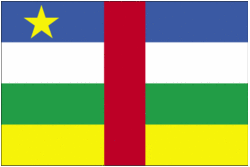 Central African national flag (Flag of Central African Republic)
 Central African Republic country profile
 Travel advice for Central African Republic
As for the Central African climate; tropical; hot, dry winters; mild to hot, wet summers.
Central African(s) speak French (official), Sangho (lingua franca and national language), tribal languages.
Places of note in Central African Republic
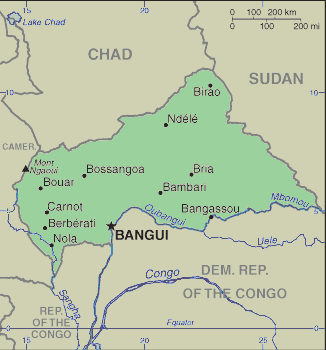 Central African map
Regions of Central African Republic
The former French colony of Ubangi-Shari became the Central African Republic upon independence in 1960. After three tumultuous decades of misrule - mostly by military governments - civilian rule was established in 1993 and lasted for one decade. President Ange-Felix PATASSE's civilian government was plagued by unrest, and in March 2003 he was deposed in a military coup led by General Francois BOZIZE, who established a transitional government. Though the government has the tacit support of civil society groups and the main parties, a wide field of candidates contested the municipal, legislative, and presidential elections held in March and May of 2005 in which General BOZIZE was affirmed as president. The government still does not fully control the countryside, where pockets of lawlessness persist.
Subsistence agriculture, together with forestry, remains the backbone of the economy of the Central African Republic (CAR), with more than 70% of the population living in outlying areas. The agricultural sector generates half of GDP. Timber has accounted for about 16% of export earnings and the diamond industry, for 40%. Important constraints to economic development include the CAR's landlocked position, a poor transportation system, a largely unskilled work force, and a legacy of misdirected macroeconomic policies. Factional fighting between the government and its opponents remains a drag on economic revitalization, with GDP growth at only 0.5% in 2004 and 2.5% in 2005. Distribution of income is extraordinarily unequal. Grants from France and the international community can only partially meet humanitarian needs.
Central African natural resources include diamonds, uranium, timber, gold, oil, hydropower
landlocked; almost the precise center of Africa
Central African religion is indigenous beliefs 35%, Protestant 25%, Roman Catholic 25%, Muslim 15%.
Natural hazards in Central African Republic include hot, dry, dusty harmattan winds affect northern areas; floods are common.
Travel Advice for Central African Republic
Central African RepublicSUMMARY
- We advise against all but essential travel to the Central African Republic (CAR). The north and west of the country, especially the areas bordering Cameroon and Chad, is particularly dangerous and should be avoided. It is no longer safe to travel by any of the road routes between CAR and Cameroon even with a military/police escort. Rebel forces are currently active in the north east of the country, particularly in the Vakaga province and around the town of Birao; and the area remains volatile. The border with Sudan is closed.
- Although elections were held successfully in May 2005, order has yet to be restored to much of the country outside Bangui, particularly in the north of the country. If you must travel outside Bangui, we strongly recommend that you check first on the current situation in the areas through which you plan to travel.
- There is no British Embassy in the CAR.
- The threat from terrorism is low but you should be aware of the global risk of indiscriminate terrorist attacks, which could be against civilian targets, including places frequented by foreigners.
- We are not aware of any British nationals who have required consular assistance in the CAR in the past year.
- We strongly recommend that you obtain comprehensive travel and medical insurance before travelling. You should check any exclusions, and that your policy covers you for the activities you want to undertake. Please see: Travel Insurance.
SAFETY AND SECURITY
Incidents of theft and robbery occur regularly and armed gangs are known to operate in the outlying areas of Bangui. Two World Health Organisation physicians were murdered by unidentified assailants approximately 250km (or three hours drive) from Bangui in April 2006. Take sensible personal security precautions and maintain a high level of vigilance in public places. We recommend that you avoid carrying valuables or wearing jewellery in public. You should avoid isolated or poorer areas of towns and walking alone at night.
Political Situation
Central African Republic Country Profile.
Following two years of internal conflict, there was a military coup on 15 March 2003, when forces loyal to General Bozize took over the capital Bangui and ousted the incumbent President Patasse.
In May 2005, General Bozize was elected as President, in elections that have been widely accepted as representative of the will of the people.
There have been a number of strikes and demonstrations linked to the non-payment of salaries to government workers. We recommend that you avoid all political rallies, demonstrations and large public gatherings.
Outside Bangui, the situation remains especially unstable and potentially dangerous. Order has yet to be restored to much of the country and armed groups are present.
Local Travel
We advise against all but essential travel to the CAR. Although peaceful elections were carried out in May 2005, order has yet to be restored to much of the country outside Bangui following the 2003 coup d’etat. If you must travel outside Bangui we strongly recommend that you check first on the current situation in the areas through which you plan to travel, with your local contacts, the local authorities and diplomatic missions in country.
The north and west of the country, especially the areas bordering Cameroon and Chad, is particularly dangerous and should be avoided. Armed gangs have ambushed and attacked villages for the purpose of robbery and kidnap for ransom. Road convoys have not been exempt from these attacks. The instability in this region has intensified in the first quarter of 2006 and appears to be spreading further south than in the past; the Mayor of Bossangoa was killed in one of these attacks in mid-March 2006. It is no longer safe to travel by any of the road routes between CAR and Cameroon even with a military/police escort. A convoy was attacked near Bouar in north western CAR during the weekend of 16/17 September 2006, and civilian workers and the military escorts killed or seriously wounded. CAR closed its border with Sudan in April 06.
Air Safety
The EU has published a list of air carriers that are subject to an operating ban or restrictions within the community. You should check the following link to see whether this will affect your travel: http://europa.eu.int/comm/transport/air/safety/flywell_en.htm
LOCAL LAWS AND CUSTOMS
Penalties for the use and possession of drugs are severe.
The purchase of diamonds or precious stones is prohibited except through those agents authorised by the Government. All cultural artefacts are subject to an export tax.
Caution and discretion must be used in the taking of photographs in public places, as permission is often required. Taking photos of Government property, uniformed Law and Enforcement Officers, Military installations and personnel, may lead to detention, subsequent fines and the impounding of cameras. The taking ofany photographs which the CAR authorities deem as damaging the imageof CAR(such as street urchins,people with handicaps/deformities) is also not permitted. The situation is more relaxed outside of the capital, where people are generally open to having their picture taken, but it is always advisable to ask first. A permit may be obtained for the more serious photographer from the Ministry of Tourism.
Homosexuality is not widely accepted in Central African society and some sexual acts between members of the same sex are illegal.
ENTRY REQUIREMENTS
HEALTH
GENERAL
There is no British Embassy in the CAR. However, there is an Acting Honorary Consul who may be able to assist in emergencies. His name is Mark Pearson and he can be contacted on mobile phone number + 236 05 73 93 or at fax number + 236 61 66 97. He can also be reached via SMS messages sent to Thuraya tel no 00 8821 650 650 415. His e-mail is: markmarkmlp@uuplus.com or markbangui@yahoo.fr.