World index ... Africa ... Cape Verde
Travelers word index

Cape Verde

Continents
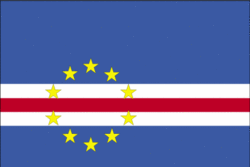
Cape Verdean flag

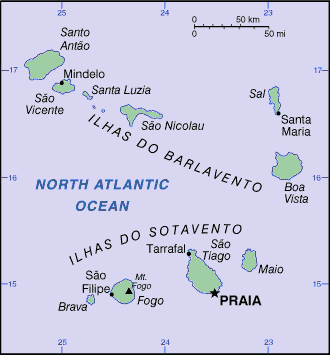
Cape Verde is located in Western Africa, group of islands in the North Atlantic Ocean, west of Senegal.

Land in Cape Verde is steep, rugged, rocky, volcanic.

Cape Verdean land covers an area of 4033 square kilometers which is slightly larger than Rhode Island
As for the Cape Verdean climate; temperate; warm, dry summer; precipitation meager and very erratic.

Cape Verdean(s) speak Portuguese, Crioulo (a blend of Portuguese and West African words).

Cape Verde country profile, Travel advice for Cape Verde

Cape Verdean Map
Places of note in Cape Verde
Praia
Mindelo
Santa Maria
Santa Cruz
São Filipe
Assomada
Tarrafal
Porto Novo
Vila da Ribeira Brava
Ponta do Sol
Vila do Maio
Sal Rei
Pombas
Porto dos Mosteiros
Regions of Cape Verde
Boa Vista
Brava
Cape Verde (general)
(CV03)
(CV06)
(CV09)
(CV12)
Maio
Mosteiros
Paul
Praia
Ribeira Grande
Sal
Santa Catarina
Santa Cruz
São Domingos
São Filipe
São Miguel
São Nicolau
São Vicente
Tarrafal

The uninhabited islands were discovered and colonized by the Portuguese in the 15th century; Cape Verde subsequently became a trading center for African slaves and later an important coaling and resupply stop for whaling and transatlantic shipping. Following independence in 1975, and a tentative interest in unification with Guinea-Bissau, a one-party system was established and maintained until multi-party elections were held in 1990. Cape Verde continues to exhibit one of Africa's most stable democratic governments. Repeated droughts during the second half of the 20th century caused significant hardship and prompted heavy emigration. As a result, Cape Verde's expatriate population is greater than its domestic one. Most Cape Verdeans have both African and Portuguese antecedents.

Country profile: Cape Verde

Map of Cape VerdePoor in natural resources, prone to drought and with little arable land, the Cape Verde islands are heavily dependent on food imports, sometimes in the form of aid.

The former Portuguese colony comprises 10 islands and five islets, all but three of which are mountainous.

During the 20th century severe droughts caused the deaths of 200,000 people and prompted heavy emigration. Today, more people with origins in Cape Verde live outside the country than inside it. The money that they send home brings in much-needed foreign currency.

From the mid-1990s, droughts cut the islands' grain crop by 80%, and in 2002 the government appealed for international food aid after the harvest failed.

Nonetheless, Cape Verde enjoys a per capita income that is higher than that of many continental African nations. It has sought closer economic ties with the US, EU and Portugal.

Tourism is on the rise, but there are concerns that it poses a threat to the Cape Verde's rich marine life. It is an important nesting site for loggerhead turtles and humpback whales feed in the islands' waters.

Cape Verde became independent in 1975, a year after its sister colony, Guinea-Bissau, won freedom from Portugal. The two countries planned to unite, but the plan was ditched after a coup in Guinea-Bissau in 1980 strained relations.

In 1991 Cape Verde held its first free presidential elections, which were won by Antonio Mascarenhas Monteiro, who replaced the islands' first president, Aristides Pereira.

  • Full name: The Republic of Cape Verde
  • Population: 482,000 (UN, 2005)
  • Capital: Praia
  • Area: 4,033 sq km (1,557 sq miles)
  • Major languages: Portuguese, Crioulo (a mixture of archaic Portuguese and African words)
  • Major religions: Christianity
  • Life expectancy: 67 years (men), 73 years (women) (UN)
  • Monetary unit: 1 Cape Verdean escudo = 100 centavos
  • Main exports: Shoes, clothes, fish, bananas, hides, pozzolana (volcanic rock, used to make cement)
  • GNI per capita: US $1,870 (World Bank, 2006)
  • Internet domain: .cv
  • International dialling code: +238

    President: Pedro de Verona Rodrigues Pires

    Cape Verde president

    Incumbent leader Pedro Pires won presidential elections in February 2006, gaining 51% of the vote and narrowly defeating his rival, Carlos Veiga.

    The pair have been Cape Verde's dominant political personalities since independence in 1975. Poverty, unemployment and the state of the economy were key issues in the 2006 poll.

    Mr Pires, from the ruling African Party for the Independence of Cape Verde (PAICV), led the country from 1975 to 1990, when he lost Cape Verde's first multi-party elections to Mr Veiga's Movement for Democracy.

    He took office again in March 2001 after beating Carlos Veiga by just 17 votes in February's elections.

    Over the years the PAICV has shed its Marxist leanings and has embraced the market economy.

    Pedro Pires was born in 1934 on the island of Fogo. He studied in Portugal and is a veteran of the struggle for independence.

    Cape Verde is a republic with a president, who is the head of state, and a prime minister who heads the government. The prime minister is appointed by parliament.

  • Prime minister: Jose Maria Pereira Neves
  • Foreign minister: Victor Manuel Barbosa Borges
  • Finance minister: Cristina Duarte

    Press freedom is guaranteed by law and is generally respected. Much of the media is state-run, but there is an active private press and a growing number of private broadcasters.

    Portuguese public TV and radio services for Africa and Radio France Internationale are relayed across Cape Verde, and Portuguese and Brazilian newspapers are available. Local newspapers use their online presence to reach the many Cape Verdeans who live overseas.

    Some radio and TV programmes are presented in the Crioulo tongue - an African-Portuguese hybrid.

    The press

  • Jornal Horizonte - daily
  • Expresso das Ilhas - weekly
  • A Semana - weekly

    Television

  • Televisao Nacional De Cabo Verde (TNCV) - state-run

    Radio

  • Radio Nacional De Cabo Verde (RNCV) - state-run
  • Radio Nova - Catholic station, Sao Vicente
  • Radio Comercial - private, Praia
  • Praia FM - private

    News agency

  • Inforpress - state-run

    This island economy suffers from a poor natural resource base, including serious water shortages exacerbated by cycles of long-term drought. The economy is service-oriented, with commerce, transport, tourism, and public services accounting for 66% of GDP. Although nearly 70% of the population lives in rural areas, the share of agriculture in GDP in 2004 was only 12%, of which fishing accounted for 1.5%. About 82% of food must be imported. The fishing potential, mostly lobster and tuna, is not fully exploited. Cape Verde annually runs a high trade deficit, financed by foreign aid and remittances from emigrants; remittances supplement GDP by more than 20%. Economic reforms are aimed at developing the private sector and attracting foreign investment to diversify the economy. Future prospects depend heavily on the maintenance of aid flows, the encouragement of tourism, remittances, and the momentum of the government's development program.

    Cape Verdean natural resources include salt, basalt rock, limestone, kaolin, fish, clay, gypsum

    strategic location 500 km from west coast of Africa near major north-south sea routes; important communications station; important sea and air refueling site

    Cape Verdean religion is Roman Catholic (infused with indigenous beliefs); Protestant (mostly Church of the Nazarene).

    Natural hazards in Cape Verde include prolonged droughts; seasonal harmattan wind produces obscuring dust; volcanically and seismically active.

    Travel Advice on Cape Verde

    Cape Verde

    This advice has been reviewed and reissued with an amendment to the Entry Requirements section (change of address for Ambassador).  The overall level of the advice has not changed.

    SUMMARY

    • There is no UK representation in Cape Verde.  However, Mr Antonio Canuto, the British Honorary Consul in Mindelo, Sao Vicente island can provide limited assistance in an emergency.

    • The threat from terrorism is low.

    • Most visits to Cape Verde are trouble-free.  The main type of incidents for which British nationals have required consular assistance in Cape Verde are crime related, loss of documents and illness.

    • We strongly recommend that you obtain comprehensive travel and medical insurance before travelling.  You should check any exclusions, and that your policy covers you for the activities you want to undertake.  Please see:  Travel Insurance


    SAFETY AND SECURITY

    Terrorism

    The threat from terrorism is judged to be low but you should be aware of the global risk of indiscriminate terrorist attacks, which could be against civilian targets, including places frequented by foreigners.  Please read Security and General Tips and Risk of Terrorism when Travelling Overseas page for further information and guidance.
    Crime
    Crime rates in Cape Verde are low but there have been incidents of muggings involving British nationals.  You should avoid carrying valuables in public and remain vigilant at all times.
    Political Situation
    The political situation is stable.  Legislative elections, which passed off peacefully, took place on 22 January 2006.
    Cape Verde Country Profile
    Road Safety
    Traffic is usually light and road conditions and driving standards are generally of a reasonable quality.
    Sea Safety
    Sea conditions around Cape Verde are sometimes treacherous.  Mariners should take local advice.  Travel by sea to the southern islands of Fogo and Brava in particular can be significantly disrupted.
    Air Safety
    The EU has published a list of air carriers that are subject to an operating ban or restrictions within the community.  You should check the following link to see whether this will affect your travel: http://europa.eu.int/comm/transport/air/safety/flywell_en.htm.


    ENTRY REQUIREMENTS

    British nationals require a visa to enter Cape Verde.  Cape Verde's Ambassador to the UK is Fernando Wahnon Ferreira, based in Brussels.  His address is: Ambassade du Cap-Vert, Avenue Jeanne 29, 1000 Bruxelles, tel. +32 2 64 69 025/64 36 270; fax 32 2 64 63 385, email: emb.caboverde@skynet.be.  For those travelling via Senegal there is a Cape Verde Embassy in Dakar.  Specialist travel agents dealing with Cape Verde can also arrange visas.


    HEALTH

    We strongly recommend that you take our comprehensive medical and travel insurance before travelling.  This should include cover for medical treatment and evacuation, accidents, cancelled flights, and stolen cash, cards, passports and luggage.  You should check any exclusions, and that your policy covers you for the activities you want to undertake.  Please see: Travel Insurance

    You should seek medical advice before travelling and ensure that all appropriate vaccinations are up to date.  For further information on health, check the Department of Health’s website at www.dh.gov.uk


    GENERAL

    If things go wrong when overseas, please see:  What We Can Do To Help.
    There is no British Embassy in Cape Verde.  The British Ambassador to Cape Verde resides at Dakar.  Mr Antonio Canuto, the British Honorary Consul in Mindelo, Sao Vicente island, can provide limited assistance in an emergency; (tel: +238 2322830), or ask for Mr Canuto's assistant, Isabel Spencer (tel: (238) 2323512/2323123; fax: +238 2321284).
    Money
    The Cape Verde Escudo is tied to the Euro at CV Esc 110.27 = 1 Euro.  Banks will exchange hard currencies.  Main hotels and restaurants will accept the major credit cards.


  • What is this world index all about?