
 Search
Traveling Luck for Burkina Faso. Burkina Faso, Africa
Burkina Faso is located in Western Africa, north of Ghana.
Land in Burkina Faso is mostly flat to dissected, undulating plains; hills in west and southeast.
Burkinabe land covers an area of 274200 square kilometers which is slightly larger than Colorado
Burkina Faso has borders with Benin for 306km, Ivory Coast for 584km, Ghana for 549km, Mali for 1000km, Niger for 628km and Togo for 126km.
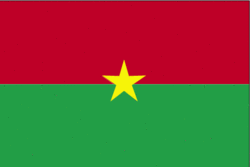 Burkinabe national flag (Flag of Burkina Faso)
 Burkina Faso country profile
 Travel advice for Burkina Faso
As for the Burkinabe climate; tropical; warm, dry winters; hot, wet summers.
Burkinabe (singular and plural) speak French (official), native African languages belonging to Sudanic family spoken by 90% of the population.
Places of note in Burkina Faso
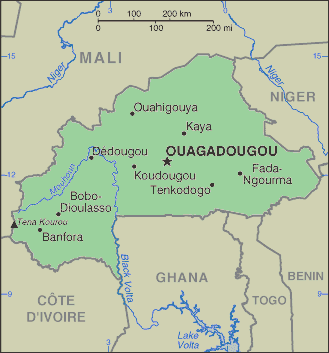 Burkinabe map
Regions of Burkina Faso
- Balé
- Bam
- Banwa
- Bazèga
- Bougouriba
- Boulgou
- Boulkiemdé
- Burkina Faso (general)
- Comoé
- Ganzourgou
- Gnagna
- Gourma
- Houet
- Ioba
- Kadiogo
- Kènèdougou
- Komondjari
- Kompienga
- Kossi
- Koulpélogo
- Kouritenga
- Kourwéogo
- Léraba
- Loroum
- Mouhoun
- Nahouri
- Namentenga
- Nayala
- Noumbiel
- Oubritenga
- Oudalan
- Passore
- Poni
- Sanguié
- Sanmatenga
- Séno
- Sissili
- Soum
- Sourou
- Tapoa
- Tuy
- (UV16)
- (UV17)
- (UV18)
- (UV22)
- (UV23)
- (UV24)
- (UV25)
- (UV26)
- (UV27)
- (UV29)
- (UV30)
- (UV31)
- (UV32)
- (UV35)
- (UV37)
- (UV38)
- (UV39)
- (UV41)
- (UV43)
- Yagha
- Yatenga
- Ziro
- Zondoma
- Zoundwéogo
Burkina Faso (formerly Upper Volta) achieved independence from France in 1960. Repeated military coups during the 1970s and 1980s were followed by multiparty elections in the early 1990s. Burkina Faso's high population density and limited natural resources result in poor economic prospects for the majority of its citizens. Recent unrest in Cote d'Ivoire and northern Ghana has hindered the ability of several hundred thousand seasonal Burkinabe farm workers to find employment in neighboring countries.
One of the poorest countries in the world, landlocked Burkina Faso has few natural resources and a weak industrial base. About 90% of the population is engaged in subsistence agriculture, which is vulnerable to harsh climatic conditions. Cotton is the key crop and the government has joined with other cotton producing countries in the region to lobby for improved access to Western markets. GDP growth has largely been driven by increases in world cotton prices. Industry remains dominated by unprofitable government-controlled corporations. Following the CFA franc currency devaluation in January 1994, the government updated its development program in conjunction with international agencies; exports and economic growth have increased. The government devolved macroeconomic policy and inflation targeting to the West African regional central bank (BCEAO), but maintains control over fiscal and microeconomic policies, including implementing reforms to encourage private investment. The bitter internal crisis in neighboring Cote d'Ivoire continues to hurt trade and industrial prospects and deepens the need for international assistance.
Burkinabe natural resources include manganese, limestone, marble; small deposits of gold, phosphates, pumice, salt
landlocked savanna cut by the three principal rivers of the Black, Red, and White Voltas
Burkinabe religion is Muslim 50%, indigenous beliefs 40%, Christian (mainly Roman Catholic) 10%.
Natural hazards in Burkina Faso include recurring droughts.
Travel Advice for Burkina Faso
Burkina FasoSUMMARY
- There is no British Embassy in Burkina Faso. The British Ambassador to Burkina Faso resides in Accra, Ghana. Our Honorary Consul can only offer limited consular assistance.
- The threat from terrorism is low.
- Most visits to Burkina Faso are trouble-free followed. The main type of incident for which British nationals require consular assistance in Burkina Faso is for replacing lost and stolen passports.
- Before travelling, you should seek medical advice and ensure that all appropriate vaccinations are up to date.
- We strongly recommend that you obtain comprehensive travel and medical insurance before travelling. You should check any exclusions, and that your policy covers you for the activities you want to undertake. Please see: Travel Insurance.
SAFETY AND SECURITY
There have been incidents involving armed groups stopping vehicles to rob them in various parts of the country, particularly at night. Incidents are more frequent on secondary roads in the east (particularly roads to Benin, Bogande and Gayeri).
You should take particular care on the road between Ouagadougou and Po. On 24 July 2005, armed attackers killed one person and injured seven others.
Street crime poses high risks for visitors. Most reported incidents involve opportunist snatches of purses, wallets, jewellery and other valuable. Thieves are particularly active in crowds. The areas near and around the UN Circle and the former Central Market in Ouagadougou experience the highest amount of street crime. You should take sensible precautions. Do not carry valuables in public places or walk alone at night.
Foreign visitors and residents in Burkina Faso are increasingly becoming targets by scam artists. The scams come in many forms, and can pose great financial loss to victims. Scam artists are also targeting individuals in the UK. Relatives or friends in the UK should first check with the person who has travelled to Burkina Faso before becoming involved in the transfer of money. If you are concerned about someone who has travelled to Burkina Faso you should contact the Consular Section of the British High Commission, Accra (E-mail: high.commission.accra@fco.gov.uk). Schemes in operation by West African criminal networks are designed to facilitate victims parting with money, known as advance fee or 419 fraud. Scam artists are also known to be targeting internet dating/personal sites with the intention of soliciting money from victims. For further information on advance fee fraud please see: http://www.met.police.uk/fraudalert.
Political Situation
Burkina Faso Country Profile.
The political situation is generally stable.
Road Safety
Travel at night, especially outside towns, is not advised. With a few exceptions, roads are poor with few street lights. There is the risk of banditry and also of hitting stray livestock. Road conditions off the main roads are often difficult, especially in the rainy season (June-September). Vehicles do not always have headlights and are often in unsound mechanical condition.
It is important not to leave clearly marked roads or tracks (or even to venture along minor roads in remote areas) except in convoy. If you break down you may not otherwise be able to attract help. Carry sufficient drinking water to last you if you break down.
Driving licences from European countries are accepted in Burkina Faso.
Air Safety
The EU has published a list of air carriers that are subject to an operating ban or restrictions within the community. You should check the following link to see whether this will affect your travel: http://europa.eu.int/comm/transport/air/safety/flywell_en.htm.
LOCAL LAWS AND CUSTOMS
ENTRY REQUIREMENTS
HEALTH
Medical facilities in Burkina Faso are very limited. For serious medical treatment, evacuation to Europe is necessary.
Burkina Faso suffers from an annual meningitis epidemic from January to May. It spreads quickly, then is rapidly stopped by the onset of the rainy season. You are strongly advised to seek vaccination against the A, C and W135 strains of the disease before travel to the region. You are also advised to avoid crowds (indoors and outdoors as the disease is easily spread).
Safe drinking water is scarce in Burkina Faso. You are advised to drink only boiled/bottled water. Remember to take adequate supplies of drinkable water if travelling in rural areas.
You should seek medical advice before travelling and ensure that all appropriate vaccinations are up to date. For further information on health, check the Department of Health’s website at: www.dh.gov.uk.
GENERAL
You should carry ID (passport or residence permit) at all times, particularly when driving or taking a taxi outside Ouagadougou, when you are likely to have to produce it.
You should reconfirm onward/return flights 72 hours in advance.
Money
Visa cards are accepted by a few of the larger hotels and restaurants in Ouagadougou (as are travellers' cheques denominated in Euros). You are unlikely to be able to use them anywhere outside the capital. Other brands of credit cards are not accepted. There are a few ATMs in Ouagadougou (Visa only). Travellers' cheques are exchangeable in banks in Ouagadougou. Euro travellers' cheques are exchanged at the fixed rate prevailing between the CFA Franc and the Euro; exchange rates on other currency travellers' cheques can be poor. In general, and in particular outside Ouagadougou, you should ensure you have enough cash to cover any eventuality.
The Central Bank (BCEAO) has issued the following new CFA notes and coins in Burkina Faso: 10,000, 5,000, 2,000 and 1,000 CFA notes; 500 and 200 CFA coins.
The old notes ceased to be legal tender on 31 December 2004.